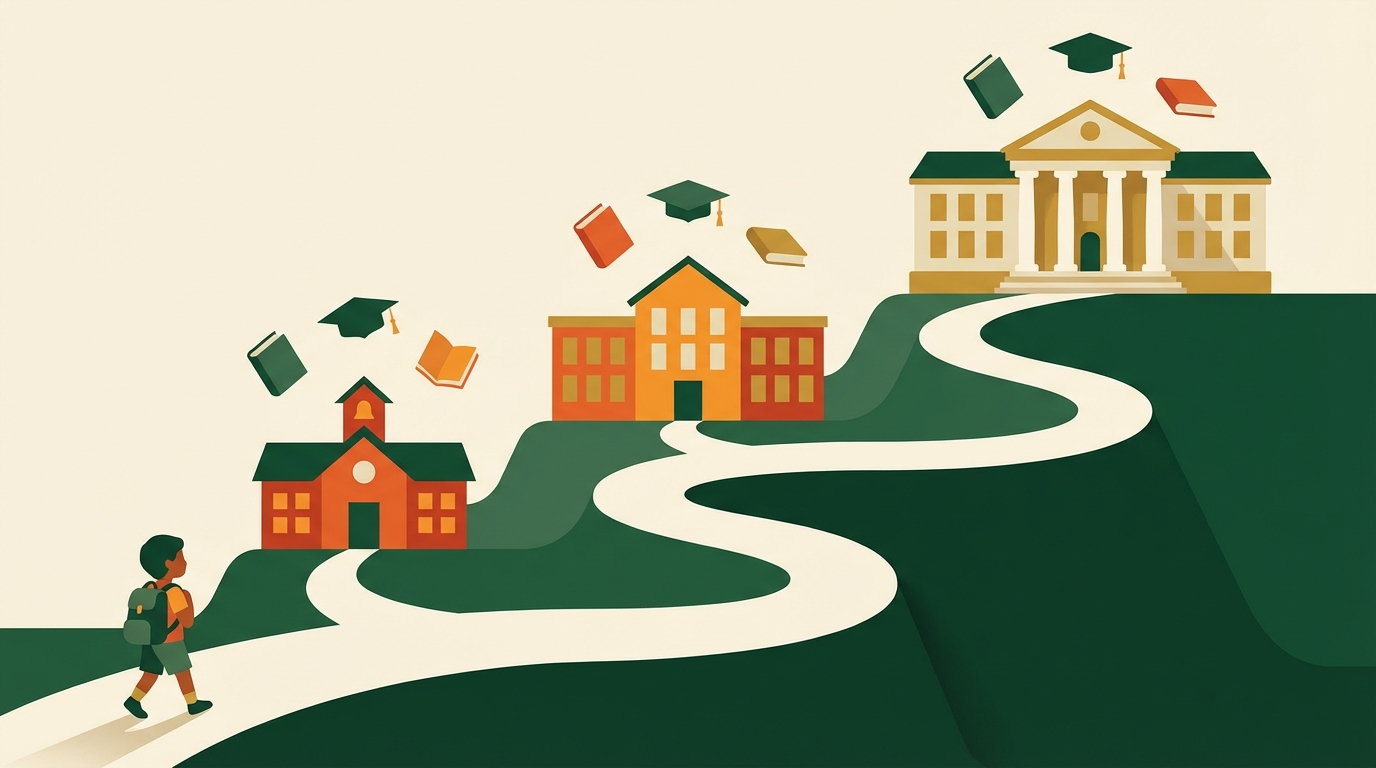
TL;DR: The Philippine education system follows a K-12 structure: one year of kindergarten, six years of elementary (Grades 1–6), four years of junior high school (Grades 7–10), and two years of senior high school (Grades 11–12). Three agencies oversee it — DepEd for basic education, CHED for higher education, and TESDA for technical-vocational training.
The Philippine education system is one of the largest in Southeast Asia, serving over 27 million learners across more than 60,000 public and private institutions. Whether you are a parent enrolling your child for the first time, a student planning your college path, or someone returning to school after years in the workforce, understanding how the system works is essential.
How does the Philippine school system compare to the US and UK?
The Philippine school system uses the American grade numbers, splits "high school" into two separate institutions, and is governed by three different agencies rather than one — those three facts get a reader from an American or British system most of the way.
One: the grade numbers are the American ones. The Philippines runs Grades 1 through 12 at essentially the same ages the United States does. A Philippine Grade 8 student is an American eighth grader. Republic Act No. 10533 sets kindergarten at "at least five (5) years old", junior high entrants at "typically twelve (12) years old" and senior high entrants at "typically sixteen (16) years old". Against England's year groups, where Year 1 is age 5 to 6, a Philippine grade sits one number below the English year.
| Philippine level | Typical age | United States | England |
|---|---|---|---|
| Kindergarten | 5 | Kindergarten | Year 1 |
| Grade 1 | 6 | Grade 1 | Year 2 |
| Grade 6 (end of elementary) | 11 | Grade 6 | Year 7 |
| Grade 7 (start of junior high) | 12 | Grade 7 | Year 8 |
| Grade 10 (end of junior high) | 15 | Grade 10 | Year 11 (GCSE year) |
| Grades 11-12 (senior high) | 16-17 | Grades 11-12 | The two sixth-form years |
Two: "high school" is two institutions, not one. In the Philippines, junior high school covers Grades 7 to 10 and senior high school covers Grades 11 to 12. There is no separate middle school: students go straight from Grade 6 at the end of elementary into Grade 7 at the start of junior high. Junior and senior high are separate stages, often at separate campuses, with a separate application. Senior high is where students pick a track, which makes it closer to the last two years of an English sixth form than to American eleventh and twelfth grade.
Three: no single agency runs the whole thing. What a single American state department of education would handle is split three ways here, and knowing which agency governs a school tells you what its credentials mean.
Which agency governs which level of education in the Philippines?
Philippine education is governed by three separate agencies: DepEd runs basic education from kindergarten through Grade 12, CHED regulates colleges and universities, and TESDA runs technical-vocational training.
What is DepEd responsible for?
The Department of Education (DepEd) oversees all basic education in the Philippines — kindergarten, elementary, junior high school, and senior high school. It manages the curriculum, sets learning standards, deploys teachers to public schools, and regulates private basic education institutions. As of SY 2024–2025, DepEd reported over 23 million enrollees in basic education, with more than 45,000 public schools nationwide.
What does CHED regulate?
The Commission on Higher Education (CHED) governs all public and private higher education institutions (HEIs) in the Philippines that offer bachelor's degrees, master's programs, and doctoral programs. It sets minimum standards for degree programs, grants permits and recognition to new schools, and manages scholarship programs like the CHED Scholarship and Tulong Dunong. In 2025, CHED unveiled a new roadmap for Philippine higher education reform aimed at improving global competitiveness.
What does TESDA do?
The Technical Education and Skills Development Authority (TESDA) manages the Philippines' technical-vocational education and training (TVET) sector. It certifies skills through National Competency assessments, registers training programs, and provides scholarships for short-term vocational courses. In 2025, TESDA expanded its reach by launching Regional TVET Innovation Centers in Tuguegarao, Tacloban, and General Santos City, along with new micro-credential programs and enterprise-based training partnerships.
What are the levels of education in the Philippines?
The Philippines has five levels of education: kindergarten (one year, age 5), elementary (six years, Grades 1–6, ages 6–11), junior high school (four years, Grades 7–10, ages 12–15), senior high school (two years, Grades 11–12, ages 16–17), and tertiary education, which is a bachelor's degree of four to five years or a TESDA technical-vocational programme. The first four levels make up the 13 years of basic education set by Republic Act No. 10533, the Enhanced Basic Education Act of 2013, and public basic education is free from kindergarten through Grade 12.
How long is kindergarten in the Philippines?
Kindergarten in the Philippines is one compulsory year, typically at age five, and it focuses on early literacy, numeracy, and socialization. Public schools offer free kindergarten, while private kindergarten tuition ranges from ₱15,000 to ₱80,000+ per year depending on the institution.
How many years is elementary school in the Philippines?
Elementary school in the Philippines covers six years, Grades 1 to 6, from about age six to age 11, and builds foundational skills in Filipino, English, Mathematics, Science, Araling Panlipunan (Social Studies), MAPEH (Music, Arts, Physical Education, and Health), and Edukasyon sa Pagpapakatao (Values Education). The language of instruction in the early grades changed recently and is covered in its own section below.
What grades are junior high school in the Philippines?
Junior high school in the Philippines covers Grades 7 to 10, four years from about age 12 to age 15, and introduces more specialized subjects, including Technology and Livelihood Education (TLE). Students begin exploring career pathways and developing higher-order thinking skills. This stage is compulsory, and public junior high schools remain free of tuition.
What is senior high school in the Philippines?
Senior high school in the Philippines is Grades 11 and 12, the final two years of basic education at about ages 16 to 17, and it prepares students for college, employment, or entrepreneurship. The old four-track, named-strand system (STEM, ABM, HUMSS, GAS, TVL, Sports, Arts and Design) has been replaced by two tracks with elective clusters underneath them, under the Strengthened Senior High School Curriculum established by DepEd Order No. 017, s. 2026. DepEd Memorandum No. 012, s. 2026 directs full implementation for incoming Grade 11 students from SY 2026-2027, following a Grade 11 pilot in SY 2025-2026.
| Track | Focus |
|---|---|
| Academic | College preparation |
| Technical-Professional (Tech-Pro) | Skills-based training, including national certifications |
DepEd's Strengthened SHS Program page lists the shared core subjects every student takes regardless of track: Effective Communication, General Mathematics, General Science, and Life and Career Skills, alongside Filipino and a Philippine history and society course. News reporting has described this as a cut from 15 core subjects to five integrated learning areas; that specific before-and-after figure comes from reporting rather than from the order itself, so we present it as reported. Our Strengthened SHS curriculum guide walks through what changed in detail, and the MATATAG curriculum guide covers the reform to the grades below it.
When does the school year start in the Philippines?
The Philippine school year does not follow the American August-to-June pattern, and it moved recently.
Under DepEd Order No. 009, s. 2026, school year 2026-2027 opens on 8 June 2026 and ends on 8 April 2027, running 201 class days. The bigger change is structural: DepEd replaced the four-quarter year with a three-term calendar, each term made up of an instructional block and an end-of-term block. Our DepEd school calendar guide has the term-by-term dates.
Two implications for anyone planning around it:
- The long break is Philippine summer, not northern summer. Classes wind down around late March and April, which is the hottest, driest stretch of the year here. A family moving from the US mid-year is arriving in the middle of a term, not at a natural break point.
- Colleges do not follow DepEd's calendar. CHED-regulated institutions set their own academic calendars, and they do not agree with each other. UST publishes its first term as running August to December. De La Salle runs three trimesters a year rather than two semesters. So "when does school start" has different answers for a Grade 4 pupil and their older sibling in first year college, in the same household.
What language are Philippine classes taught in?
Filipino and English are the media of instruction in Philippine schools, with regional languages as auxiliary media, and the rules for the youngest grades changed in the last two years.
Republic Act No. 10533 originally required the mother tongue to be the medium of instruction at the bottom of the system: "For kindergarten and the first three (3) years of elementary education, instruction, teaching materials and assessment shall be in the regional or native language." That was the Mother Tongue-Based Multilingual Education (MTB-MLE) policy, and it applied nationwide.
That requirement has been discontinued. Republic Act No. 12027, which lapsed into law on 10 October 2024, amended Sections 4 and 5 of RA 10533 to end the use of the mother tongue as the medium of instruction from kindergarten to Grade 3, and made it optional in monolingual classes. The medium reverts to Filipino and English, with regional languages serving as auxiliary media. If you are reading older guides to the Philippine system, including ones still online, this is the point where they are out of date.
Above that level, the practical pattern is a split one. Mathematics, Science and English are generally taught in English; Filipino, Araling Panlipunan and values education are taught in Filipino. Higher education is overwhelmingly English-medium, which is the reason Philippine universities recruit international students in the first place, and the reason a medical degree here satisfies foreign regulators' English-medium requirements.
For a family moving here, the upshot is that an English-speaking child is not stepping into a foreign-language classroom in most subjects, but will meet Filipino as a subject and, in the early grades depending on the school, as a language of instruction.
How long is a college degree in the Philippines?
A bachelor's degree in the Philippines typically runs four to five years, taken after senior high school at any of the country's roughly 1,900 CHED-regulated higher education institutions, though medical degrees and law programs take longer.
Is college free in the Philippines?
College is free at state universities and colleges (SUCs) and local universities and colleges (LUCs) under Republic Act 10931, the Universal Access to Quality Tertiary Education Act signed in 2017, which covers tuition and miscellaneous fees. The law also covers free TVET programs at state-run technical-vocational institutions. Students at private HEIs can apply for the Tertiary Education Subsidy (TES) for financial assistance.
What does accreditation mean for a Philippine school?
Accreditation in the Philippines is a voluntary quality assurance process handled by agencies under the Federation of Accrediting Agencies of the Philippines (FAAP), and not every school takes part:
- PAASCU — Primarily accredits Catholic schools
- PACUCOA — Accredits non-sectarian private institutions
- AACCUP — Accredits state universities and colleges
Accreditation levels range from Level I (initial) to Level IV (highest distinction), with each level signaling stronger quality systems, better learning outcomes, and more robust research programs.
What is TESDA technical-vocational training?
TESDA offers hundreds of short-term technical-vocational training programs in the Philippines — from welding and automotive servicing to web development and caregiving — that can be completed in weeks or months, as an alternative to a four-year degree. Graduates earn National Certificates (NC I through NC IV) recognized by employers nationwide and, increasingly, abroad.
A landmark collaboration between CHED and TESDA now allows TVET graduates to earn college credits through the Philippine Qualifications Framework, making it easier to transition from vocational training to a bachelor's degree.
What is the difference between public and private schools in the Philippines?
Public schools charge no tuition in basic education and teach the large majority of Philippine learners — a share widely reported at about 87%, though DepEd's own current release is the figure to check — while private schools charge roughly ₱15,000 to ₱300,000+ a year.
| Factor | Public Schools | Private Schools |
|---|---|---|
| Tuition | Free (basic education) | ₱15,000–₱300,000+/year |
| Class Size | 40–60 students typical | 20–35 students typical |
| Facilities | Varies widely; classroom shortage of 148,000+ | Generally better-equipped |
| Curriculum | DepEd standard | DepEd standard + enrichment programs |
| Enrollment Share | ~87% of basic education learners | ~13% of basic education learners |
Public schools often face overcrowding — DepEd has reported a shortage of over 148,000 classrooms as of 2025. Private schools offer smaller class sizes and enhanced programs but come with significant tuition costs.
How has the Philippine education system changed?
The Philippine education system moved from a 10-year basic education cycle to the current 13-year K-12 structure in 2013 under Republic Act 10533, and has kept changing since:
- Pre-2013: The Philippines used a 10-year basic education cycle (6 years elementary + 4 years high school), making it one of only three countries worldwide with a 10-year pre-university program.
- 2013 — RA 10533 (K-12 Law): Added kindergarten, Grade 11, and Grade 12 to the cycle, aligning the Philippines with international standards.
- 2017 — RA 10931 (Free Tuition Law): Made college free at all state universities and colleges.
- 2024 — RA 12027 (Mother Tongue Law): Lapsed into law on 10 October 2024, discontinuing the mother tongue as the medium of instruction from kindergarten to Grade 3 and making it optional in monolingual classes.
- 2025–2026 — Strengthened SHS Curriculum: Piloted for Grade 11 in SY 2025-2026, then established by DepEd Order No. 017, s. 2026 and directed into full implementation for incoming Grade 11 from SY 2026-2027 by Memorandum No. 012, s. 2026. Two tracks replace the old strands.
- 2026 — Three-term school calendar: DepEd Order No. 009, s. 2026 replaced the four-quarter year with three terms from SY 2026-2027.
Sources
- Republic Act No. 10533 — Enhanced Basic Education Act of 2013 (full text)
- Republic Act No. 12027 — discontinuing the mother tongue as medium of instruction from kindergarten to Grade 3 (full text)
- DepEd — Strengthened Senior High School Program (official hub)
- DepEd — DO 017, s. 2026, Strengthened Senior High School Curriculum (official)
- DepEd — DM 012, s. 2026, Full Implementation of the Strengthened SHS Curriculum in SY 2026-2027 (official)
- DepEd Order No. 009, s. 2026 — Guidelines on the Implementation of the Three-Term School Calendar in Basic Education (SY 2026-2027 opening and closing dates and class-day count)
- GMA News Online — EXPLAINER: How the new three-term school calendar will work for SY 2026-2027
- GOV.UK — The national curriculum: key stages, ages and year groups in England
- University of Santo Tomas — Tuition Fees page, showing first term A.Y. 2026-2027 running August to December
Enrolment counts, institution counts and classroom-shortage figures cited in the sections above come from widely reported DepEd and CHED statements. They are indicative rather than independently verified here, and should be checked against the agencies' own current releases before being quoted.
Want to explore schools in your area? Use our search tool to browse thousands of schools across the Philippines — compare tuition fees, facilities, and reviews to find the right fit for your family. Start with schools in Metro Manila or explore review centers for board exam preparation.


