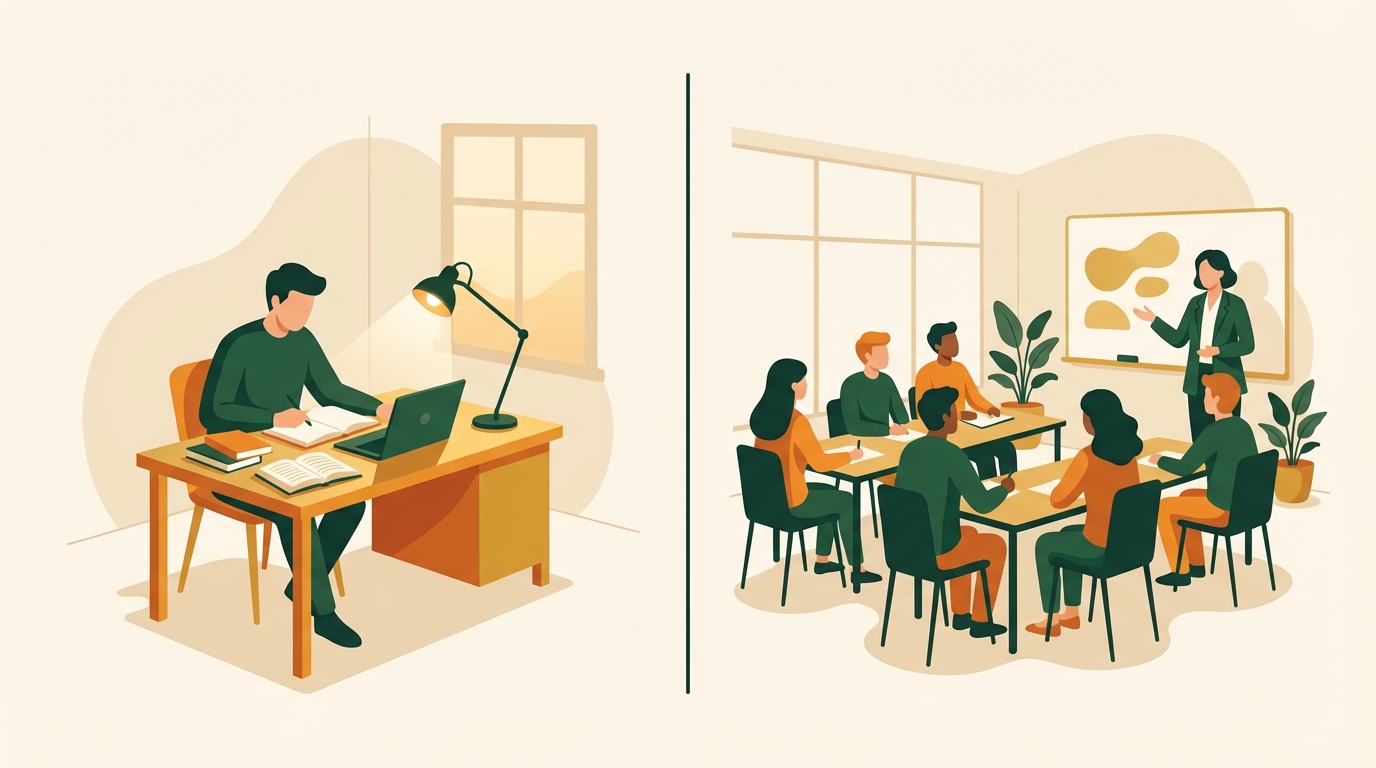
TL;DR: Nobody can tell you which approach passes more people, because PRC publishes board results by school of graduation and never by preparation method. What is real: a review centre buys structure, curated coverage, exam simulation and peer accountability; self-review costs a fraction and offers total flexibility but demands discipline most people overestimate in themselves. Review centres are also entirely unregulated since the Supreme Court struck down EO 566 in 2009, so any quality claim is self-reported. Decide on your own discipline, your budget, and how much the cost of failing would hurt.
Introduction
Scroll any CPALE, NLE or LET reviewee group and you will find the same argument on loop: people who swear their review centre made the difference, and people who passed alone and resent being told they needed one.
Both are describing real experiences. Neither is describing evidence, because the evidence does not exist. What follows separates the parts of this decision that are verifiable from the parts that are anecdote, and gives you something to decide on.
What can and cannot be known
The data does not exist
PRC does not track preparation method. For each administration it publishes a Performance of Schools report ranking institutions by their own graduates' results. That is the only official, audited performance data in the licensure system — and it is about universities, not review centres and not study methods.
There is no PRC dataset comparing review centre enrollees with self-reviewers. Anyone who quotes one has invented it. This cuts in both directions: the review industry cannot show you it works, and self-review advocates cannot show you it does not.
The industry is unregulated
In Review Center Association of the Philippines v. Ermita, G.R. No. 180046, decided 2 April 2009, the Supreme Court declared Executive Order No. 566, issued in 2006 to place review centres under CHED supervision after the nursing board leakage, and CHED Memorandum Order No. 30, s. 2007, both void for being unconstitutional — the President had expanded CHED jurisdiction beyond RA 7722 without enabling legislation.
Since then no government body licenses, accredits, inspects or ranks review centres. Topnotcher tallies, "number one" claims and guaranteed passing rates are self-reported and verified by nobody. That is not an accusation; it is the regulatory position, and it means the burden of checking a centre falls entirely on you.
What national passing rates do and do not tell you
Recent PRC results, for scale:
| Examination | Administration | Result |
|---|---|---|
| Certified Public Accountants | May 2026 | 3,004 of 9,745 passed (30.8%) |
| Nurses | November 2025 | 40,692 of 45,192 passed (90.0%) |
| Nurses | February 2026 | 3,611 of 8,162 passed (44.2%) |
| Professional Teachers, elementary | March 2026 | 18,376 of 32,796 passed (56.0%) |
| Professional Teachers, secondary | March 2026 | 45,001 of 61,561 passed (73.1%) |
Read these carefully. The two nursing rows are the same examination six months apart, and the difference is cohort composition — a large November intake of fresh graduates against a small off-cycle February intake weighted towards repeaters. A national rate describes who sat the exam at least as much as it describes difficulty, and it says nothing at all about how any of them prepared.
What it does tell you is where the stakes are highest. At roughly 30 percent, the CPALE punishes under-preparation far more expensively than the secondary LET at 73 percent. That should weigh on the decision more than any marketing claim.
The two approaches
Self-review
Preparing independently: building your own schedule and syllabus, sourcing your own materials, setting and marking your own practice exams, and supplying your own accountability.
Review centre enrolment
Paying for a structured programme: a predetermined curriculum and schedule, subject specialists, official handouts, regular quizzes and mock exams with feedback, and a cohort of fellow reviewees in a physical or virtual room.
Cost
We do not publish peso ranges for review programmes here, and you should distrust guides that do — advertised rates vary by centre, branch, examination and promotional cycle, and are only meaningful as a current quote. What is stable is the shape of each cost.
What self-review costs
- Textbooks and reference materials
- Printed handouts, whether bought new or secondhand
- Practice question banks or reviewer books
- Internet, for online resources and practice tests
- Your own time building the syllabus and schedule, which is real work
What review centre enrolment costs
- Tuition, sometimes itemised separately from materials and mock exams
- Accommodation, if you relocate to a centre city
- Food away from home and daily local transport
- Incidentals across three to four months
For anyone outside the major cities, accommodation and food typically dwarf tuition. That is the actual financial gap between the two approaches — not the tuition line. Get an itemised quote before comparing anything; our guide to review centre costs sets out what to ask for.
The cost of failing
The saving only holds if you pass. Failing costs another examination fee, six months of unlicensed earnings, and often the review centre tuition you were trying to avoid — paid later, on a second attempt, with less confidence.
How bad the failure is depends on your board. RA 9173 Section 15 gives nurse licensure examinees a removal examination: reach a 75 percent general average but fall below 60 percent in a subject and you retake only that subject, needing at least 75 percent in it. The teacher licensure examination has no partial retake — you sit the whole thing again. Know which regime you are under before you weigh the risk.
Detailed pros and cons
Self-review, in favour
- Minimal cost, especially with no relocation.
- Complete flexibility over what, when and how long.
- Customised weighting. You can spend disproportionate time where you are weak — a real advantage on examinations with lopsided subject weights, such as the elementary LET where Professional Education alone carries 60 percent.
- No commute, no fixed timetable, no dead hours.
- A transferable skill. Teaching yourself a body of knowledge is worth having beyond this exam.
Self-review, against
- You have to build the syllabus. Deciding what to study, in what order and how deeply is itself a substantial job, done before any studying happens.
- No one to ask. A concept you cannot crack alone can cost days.
- Weak exam simulation. Setting and sitting your own timed mocks under realistic conditions is possible but hard, and most people quietly do not.
- No external accountability. Nothing surfaces a slipping schedule until it is too late.
- Isolation over three to four months is harder than most people plan for.
- Stale materials. Without curation you can revise from a reviewer that predates a change to the examination — a live risk for teacher licensure examinees, where PRC realigned the LEPT with the revised teacher education curriculum from the September 2025 administration.
- Untested nerves. You arrive at exam day never having sat anything resembling exam day.
Review centre, in favour
- A curriculum someone else built, sequenced and depth-weighted for you.
- Subject specialists who teach the same material every cycle and know where examinees typically break.
- Curated, current materials — worth most where the examination has recently changed.
- Regular timed mocks with marking and item analysis, which is the closest available proxy for readiness.
- A cohort. Motivation from proximity to people doing the same thing.
- Accountability through a schedule and attendance expectations.
- Longevity as a rough signal. Not proof of quality, since nothing is verified, but a centre that has run the same programme for many cycles has at least survived its own alumni.
Review centre, against
- Significant cost, especially once relocation is priced in.
- A fixed pace that is too fast on your weak areas and too slow on your strong ones.
- Built for the average student, not for your profile.
- Geographic constraint, unless the online programme is genuinely equivalent.
- Passive attendance. Sitting through every session is not the same as learning, and attendance is easy to mistake for progress.
- Schedule rigidity that collides with work and family.
The hybrid approaches
Most people who pass use some combination.
Self-review with purchased materials. Study independently but buy official review centre handouts and question banks. Best for strong self-studiers who want curated content without the timetable. Check edition dates.
Affordable online programme plus independent study. Enrol in an online review for structure and materials, then supplement heavily on your own. Best for budget-conscious reviewees who know they need some external scaffolding. See online vs classroom review.
Full programme plus extra self-study. Enrol in a complete review and add two to four independent hours daily. The most expensive option and, for high-stakes low-pass-rate examinations, often the rational one.
A decision framework
Lean towards self-review if:
- You graduated with a strong academic record from a programme that performs well in PRC Performance of Schools
- You have demonstrated, not assumed, self-discipline over months
- You cannot afford tuition plus living expenses without borrowing
- You have access to current, quality materials
- You are a retaker who already knows the format and the specific area that failed you
- You learn best independently
Lean towards a review centre if:
- You are a first-time taker unfamiliar with the format
- Procrastination is a known pattern for you
- Your board has a low national passing rate, as the CPALE does at around 30 percent
- You have been out of school for more than a year
- Your examination has recently changed and you cannot confidently curate current material
- You learn best socially and by discussion
- Your school Performance of Schools record is weak
- You can afford it
What successful self-reviewers do differently
- Write the plan before day one — daily schedule, weekly targets, monthly milestones, mapped to the official subject weights rather than to the number of chapters.
- Source current materials, borrowing from recent review centre enrollees or buying official handouts, and checking edition dates.
- Sit a timed full-length mock every week under real conditions: correct block length, correct medium, no phone.
- Track the floor, not just the average, where the exam has a per-subject minimum.
- Join a study group, even an informal one online, purely for accountability.
- Treat review as full-time work during the review period.
- Set boundaries and hold them — hours, sleep, social media, and days off that are actually planned rather than drifted into.
What successful review centre students do differently
- Attend everything. The value you paid for is the sessions.
- Sit at the front and actually engage.
- Review the same day, rather than accumulating a backlog of unprocessed notes.
- Finish every practice set, including the hard ones, especially the hard ones.
- Add two to four hours of independent study daily on top of lectures.
- Analyse mock exam mistakes rather than only recording the score.
- Form a study group with committed classmates.
Before you decide, do this
Whichever way you are leaning, do these two things first:
- Look up your school in PRC Performance of Schools for your board. It is the only audited performance data in the system and it tells you something real about the preparation you have already had.
- Sit one full-length timed mock now, before you spend anything. A diagnostic taken cold is the most useful hour in this whole decision, and it is free.
Related reading
- How to choose a review centre
- Is a review centre worth it?
- Online vs classroom review
- Group study vs review centre
- How long should you review?
- What review centres cost
Sources
- Review Center Association of the Philippines v. Ermita, G.R. No. 180046, 2 April 2009
- PRC results releases for the May 2026 CPALE, the November 2025 and February 2026 nurse licensure examinations, and the March 2026 licensure examination for professional teachers
- PRC Performance of Schools reports, published per administration
- Republic Act No. 9173, Philippine Nursing Act of 2002, Section 15
Whichever route you take, SchoolFinderPH can help you compare options by exam type, location and format — Manila, Cebu City, Davao City, Baguio and more than a hundred other locations.