TL;DR: Two facts explain almost everything about Montessori pricing in the Philippines. First, no Philippine agency defines or accredits Montessori — DepEd recognises schools under DepEd Order No. 88, s. 2010, and says nothing about method, so the name is unregulated. Second, no government subsidy reaches the levels where most Montessori programmes sit: the ESC grant starts at Grade 7 and the Senior High School voucher at Grade 11, so preschool and elementary Montessori is paid entirely out of pocket. Those two together are why the range is so wide and why verifying a school matters more than comparing prices.
The regulatory picture, which is the part nobody explains
Parents comparing Montessori schools usually assume there is some standard behind the word. There is not, in the Philippine regulatory sense.
What DepEd regulates is the school. A private basic education school operates under a permit or government recognition, governed by DepEd Order No. 88, s. 2010, the Revised Manual of Regulations for Private Schools in Basic Education. That framework covers things like the school's authority to operate specific grade levels, its records, and — under Section 9.1 — its freedom to offer institutional subjects reflecting its own philosophy, mission and vision, provided they do not substitute for the prescribed curriculum. DepEd Order No. 017, s. 2026 cites that same Section 9.1 when it allows private schools to add institutional subjects to the Senior High curriculum.
What DepEd does not regulate is pedagogy branding. There is no DepEd definition of Montessori, no register of Montessori schools, no minimum guide qualification, no required material set, and no inspection against Montessori criteria. A school may use the word with no obligation to anything.
The credentialing that does exist is international and voluntary. The Association Montessori Internationale and the American Montessori Society train and diploma Montessori guides, by age level. Those diplomas belong to individual adults, not to schools, and a school employing one diplomate is not thereby a Montessori school throughout.
None of this makes Montessori schools suspect. It means the burden of verification sits entirely with you, and that a price difference between two schools calling themselves Montessori may reflect a genuine difference in method or nothing at all.
Why nothing subsidises it
The Philippines does subsidise private basic education, substantially. It just does not do so where Montessori mostly operates.
DepEd Order No. 011, s. 2026 (Revised E-GASTPE Guidelines) governs both schemes:
| Programme | Grade levels | Amount per year |
|---|---|---|
| ESC grant | 7 to 10 | ₱13,000 NCR / ₱11,000 highly urbanised cities outside NCR / ₱9,000 elsewhere |
| SHS Voucher | 11 and 12 | ₱22,500 / ₱20,000 / ₱17,500 for priority categories A-C; ₱18,000 / ₱16,000 / ₱14,000 for D-E |
The overwhelming majority of Montessori provision in the Philippines is toddler, Casa and elementary. Both programmes begin above that. Kindergarten is free in public schools; there is no equivalent voucher for a private preschool place.
So when you compare a Montessori preschool against, say, a private junior high school with the same headline fee, the private junior high may be receiving ₱9,000 to ₱13,000 a year of public money that the preschool does not. The comparison is not like for like.
The two rules that do apply to a Montessori school's fees are the same ones that apply to any private school: Section 42 of Batas Pambansa Blg. 232 leaves the school to set its own rates, and RA 6728 requires consultation with duly organised parents and teachers associations before a proposed increase (Section 10) and requires 70% of any increase to go to staff salaries, wages, allowances and benefits (Section 5(2)).
What we removed from this guide
The earlier version of this page carried a three-tier fee structure with peso ranges, named specific schools with specific annual amounts, gave a preschool fee table by area, and gave regional ranges for Metro Manila, Cebu, Davao and the Visayas.
None of those figures could be traced to a school publication. They have been removed rather than restated more vaguely. Every Montessori school in the country will send you its own current schedule of fees if you ask admissions, and that document is worth more than any range.
What actually drives the cost
The inputs below are the ones that move a Montessori school's fees, and each of them is something you can check on a visit. That makes them more useful than a price bracket.
Guide training. An AMI or AMS diploma is a substantial, expensive qualification, held for a specific age level. A school staffing every classroom with diplomate guides is carrying a payroll a school with in-house-trained teachers is not. Ask how many guides hold a diploma, from which body, for which level, and whether the guide for your child's classroom is one of them.
The material set. Authentic Montessori materials are specific, standardised objects — the pink tower, the golden beads, the moveable alphabet, the sensorial series — and a complete set for one classroom is a significant capital purchase, often imported and replaced as it wears. A room with a partial set cannot run the full sequence, and it costs much less to equip.
Adult-to-child ratio and class structure. The method assumes a trained guide plus an assistant working with a mixed-age group over a long uninterrupted work period. Both adults are payroll.
The prepared environment. Space, child-scaled furniture and the shelving layout are part of the method rather than decoration, and they cost floor area.
Session length. Half-day and full-day programmes are priced differently, and full-day programmes carry lunch, rest and staffing implications.
Schools investing in all of these sit at the top of the range. Schools using the name with a conventional programme underneath sit at the bottom. The label alone will not tell you which you are looking at; these five questions will.
How to verify a school in five checks
-
Ask for guide credentials, by classroom. Which body issued the diploma, for which age level, and who is teaching your child's group. A school proud of its training answers this immediately and in writing.
-
Observe a working classroom during a normal work period — not an open house performance. You should see children choosing and returning materials independently, working at different things at once, and a guide moving between individuals rather than addressing the room. If it looks like a conventional class with Montessori materials on a shelf, that is what it is.
-
Check the age grouping. Three-year spans are structural to the method: roughly 3-6 at Casa level, then 6-9 and 9-12 at elementary. Same-age classes are the single clearest sign the method has been adapted away.
-
Look at the materials themselves. Are the full sequences present, in good condition, at child height, and evidently used? Missing pieces mean the sequence cannot be completed.
-
Confirm the school's DepEd status. Ask which grade levels the school holds a permit or government recognition for. This is what allows it to issue the SF 9 report card and SF 10 permanent record your child needs to transfer anywhere, under DepEd Order No. 54, s. 2016. Ask before enrolling, not when you want to leave.
Getting the real number
- Ask admissions for the current schedule of fees for the specific level and session length, in writing.
- Ask what is inside the fee and what is extra. Materials, books, snacks, uniform if any, field trips and assessment charges are bundled at some schools and separate at others. This is the main reason two schools with the same headline fee cost differently.
- Ask which charges are one-time. Application, entrance, development and reservation fees are usually first-year, and they distort a year-on-year comparison badly.
- Ask about discounts and get the terms. Sibling, full-payment and early-enrolment discounts are common; the conditions vary.
- Ask about the fee trajectory. Elementary usually costs more than Casa at the same school. Ask for the current schedule at the level your child will be in three years from now, not just next year.
- Ask whether there is any financial assistance. Some schools maintain small partial-scholarship or staggered-payment arrangements. They rarely advertise them.
What to expect at each level
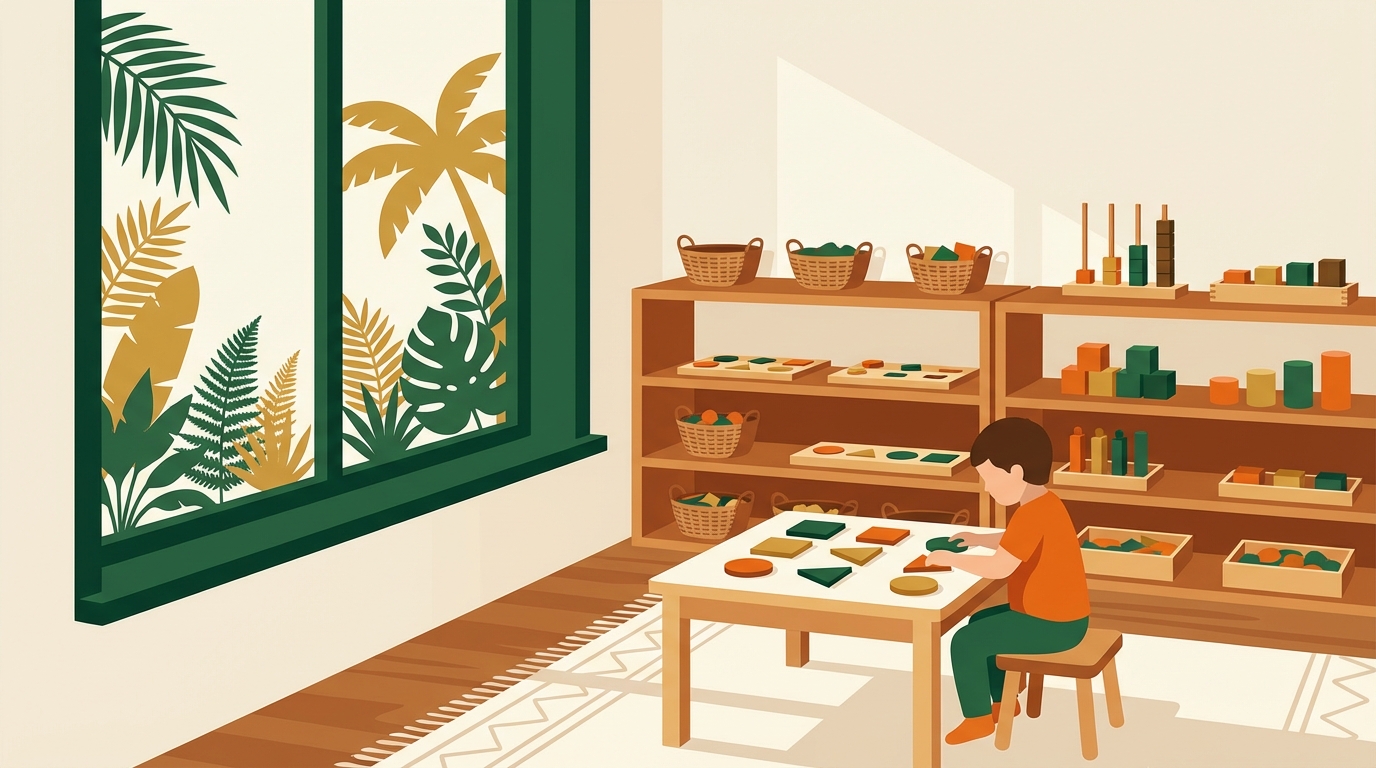
Casa or primary, roughly ages 3 to 6. Practical life, sensorial materials, language and mathematics manipulatives, in a mixed-age group with a guide and an assistant over a long uninterrupted work period. Half-day and full-day options are usually both offered.
Elementary, roughly ages 6 to 12. Integrated study connecting science, history, geography and language through narrative and research, in 6-9 and 9-12 groupings, with increasing independence in choosing and pursuing work. Fewer Philippine schools run a full elementary programme, and it demands more of both guide training and materials.
Adolescent programmes, roughly ages 12 to 15. A small number of Philippine schools run one. They emphasise community work, micro-enterprise and applied academics. If this matters to you, ask early which schools continue past elementary, because most do not.
Find a school
Browse Montessori and other private schools across the Philippines on SchoolFinderPH — Metro Manila, Cebu, Davao, Iloilo and elsewhere — then request each school's own schedule of fees.
Related reading: O.B. Montessori tuition, preschool tuition costs, choosing a preschool checklist, nursery vs preschool vs kinder, and private vs public school costs.